Empowering users to self serve
Who: Leading Vacuum Company (LVC)
What: Voice Application
When: 6 Month Project
Why: The LVC's popular vacuum products are generating high volumes of costly calls and emails, making the current approach unsustainable.
How: With a low budget - Identify the underlying cause of the problem, develop strategies to lower costs without sacrificing customer experience, and address user issues contributing to the problem.

Project Summary
Our team was tasked with reducing the high volume of customer inquiries regarding power and performance issues with the LVC’s new cordless vacuums. Through a comprehensive analysis, I discovered that users weren't properly caring for their machines and were vacuuming more frequently, exacerbating the issue.
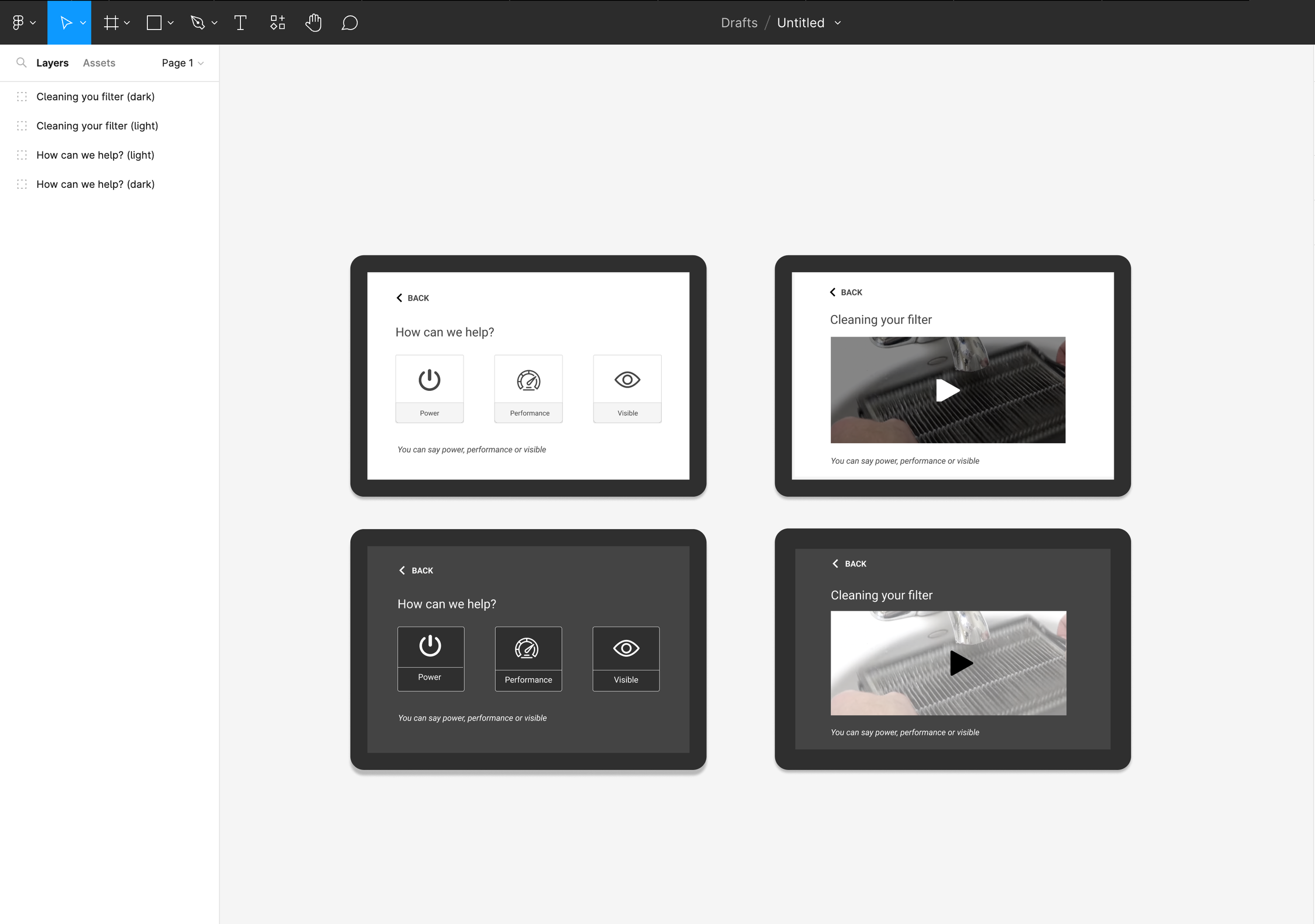
To address this root cause, I developed a voice experience that empowered customers to diagnose and troubleshoot their issues independently, reducing the volume of inquiries received by the customer service team. Additionally, I included a maintenance reminder to encourage customers to service their machines regularly, ultimately preventing issues from occurring in the first place. This solution has been released and piloted in Germany and US.
Discovery Period - Finding the problem
Research: Analysis of Call Centre Data & Web Analytics//Heuristic Evaluation//Customer Reviews//Stakeholder interviews
As a result of having a tight budget, I focused most of my research efforts on usability testing. Initially, I analysed call centre data to determine the frequency of calls related to particular issues and machines in order to comprehend the problem at hand. Subsequently, I investigated why users were not using the current resolution pathway available on the website. Finally, I reviewed user feedback to identify any underlying factors contributing to the frequent malfunctioning of specific machines and problems by examining their behaviours and contextual information.
Call Centre Data
Performance and Power issues largest concern and stakeholder interviews highlighted users were poorly servicing their machines.
Logs showed customers contacted regarding performance and power issues with cordless machines. The Customer team supported diagnosis over the phone, typically related to lack of servicing, blockages, and filter cleaning. Power issues were often confused with blockages due to safety mechanism. Some machines broke due to lack of maintenance. The LVC replaced whole machines instead of parts, exacerbating the issue.
Customer Reviews
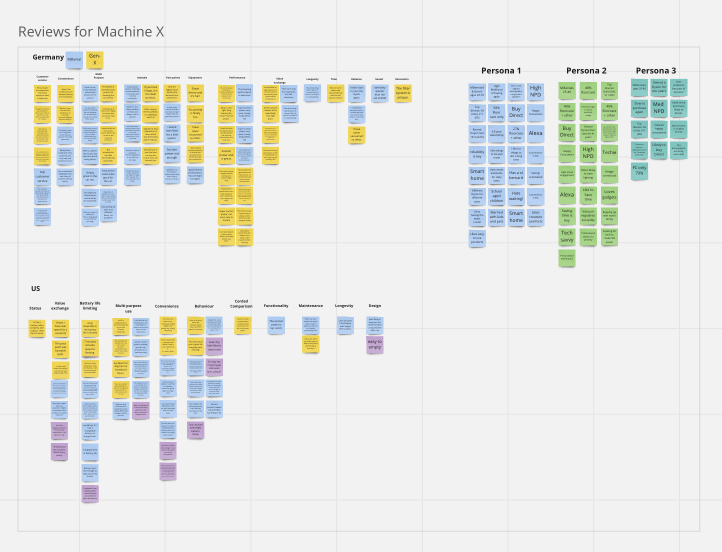
Users commented on the ease of use of their cordless machines encourage frequent use and therefore experience more malfunctions.
After analysing call centre data, I noticed a pattern of issues with specific machine models. Positive reviews indicated that cordless vacuums made cleaning easier, leading to more frequent use. I hypothesised that increased usage and lack of maintenance caused malfunctioning. Reviews mentioning malfunctioning cited time and convenience as customer priorities.
Heuristic Evaluation & Website Analytics
A high bounce rate suggested users were not using the current resolution pathway. A heuristic evaluation suggests cognitive load.
The LVC’s website was experiencing a high bounce rate for its diagnostics tool. After conducting a heuristic evaluation, we found that the website contained excessive information, resulting in cognitive overload. The language used was technical and confusing, and the search functionality did not effectively capture user input for common issues. These factors may have contributed to the high bounce rate.
Aligning the problem with the opportunity
Empower users to diagnose their issues and maintain their machines whilst finding the entry point to the MVP for the pilot.
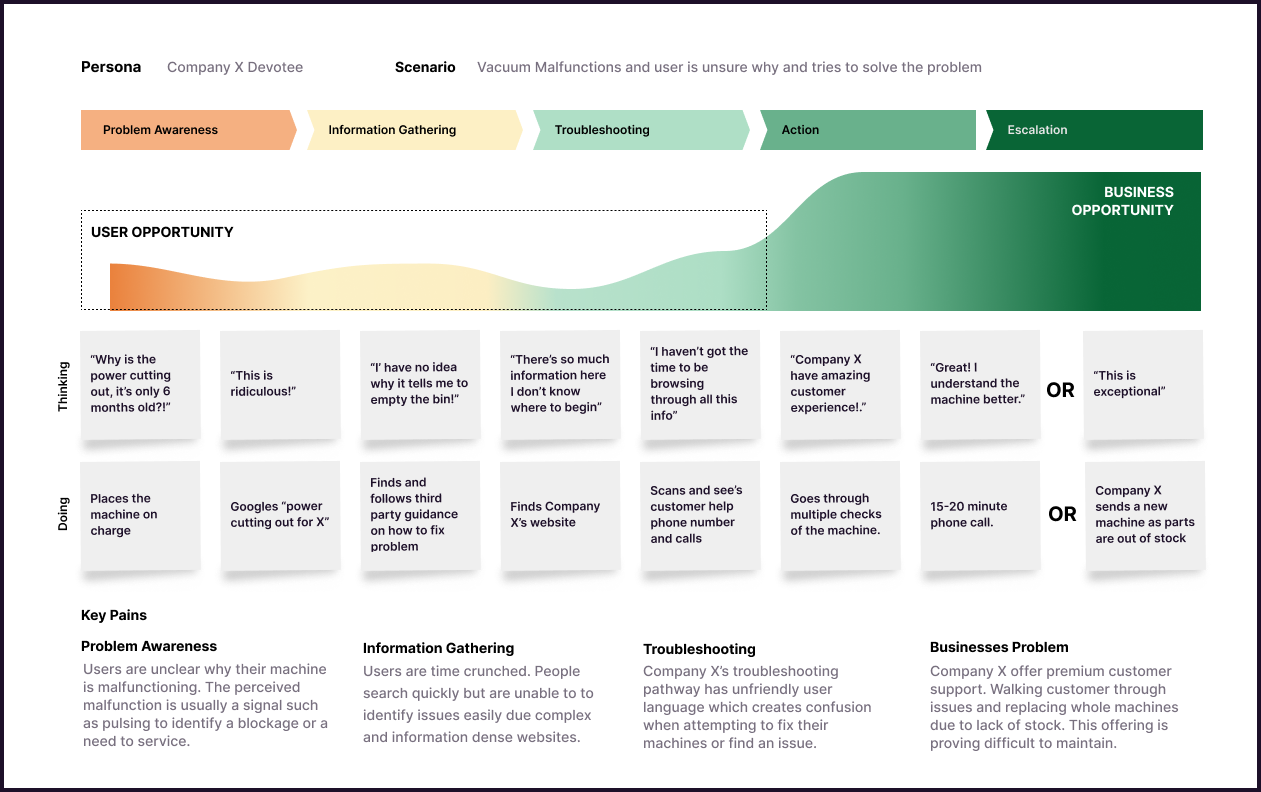
Journey Map: Macro Journey
To gain insight into the customer journey, I created two journey maps. The first map outlined the macro journey from problem realisation to issue resolution, while the second focused on the micro journey of resolving issues through the customer call centre. My aim was to identify the most valuable area to the user for the pilot. To achieve this, I proposed a voice system that could efficiently deliver the necessary information and cutting through the noise and help users resolve their problems. This secondary aim would be to tackle the underlying issue of poorly maintained machines by incorporating a maintenance features within the system.
The business opportunity
Working with the business strategist we aligned on business and user need, creating savings on reducing calls and emails and in the long-term reducing replacement machines being sent.
To my understanding, focussing on these areas could also bring the most value not just to the user but also financially. By cross-referencing my work with the business strategist we concluded that reducing calls and emails through identifying performance and power and signposting to resolve could result in significant cost savings. Additionally, by developing a product that enables customers to understand and service their machines, we could minimise the need for machine replacement and avoid long-term issues which in theory could save the company a substantial amount but this KPI would take more time to validate.
meeting the user need
Pitching back to the client and they said no
Client wanted to de-prioritise maintenance and add step by step resolution pathway within the voice experience.
The client saw the understanding of a maintenance feature within the app but did not want this as a priority. After negotiation the client wanted to diagnose but also give step by step instructions through a voice skill to fix the areas of performance and power. I negotiated a maintenance reminder within the system as a secondary aim.
Synthesis 1/5
design, Prototype & iterate
Prioritising, roadmaps and the build
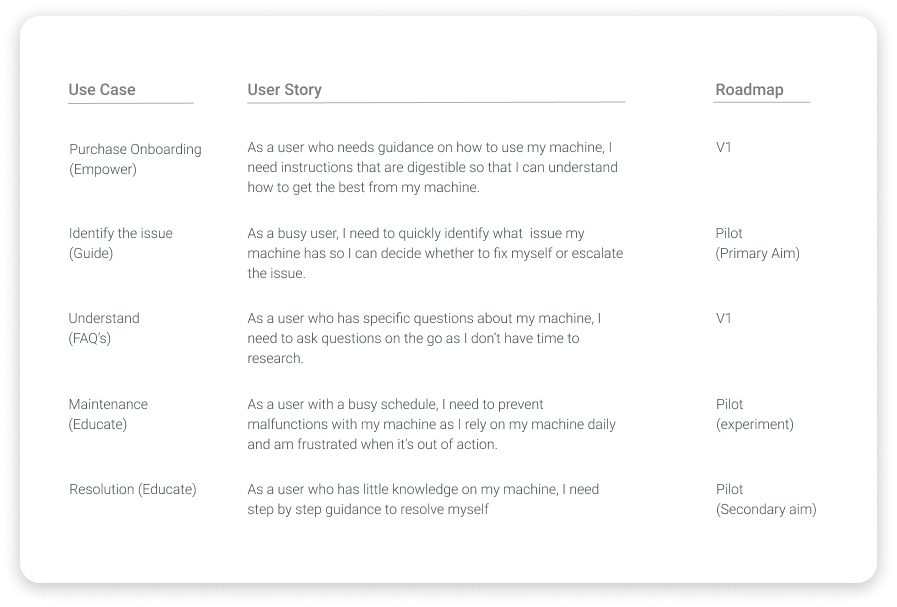
Moving ahead, I had a basic framework of the product envisioning a set of features that would cater to user needs and alleviate their pain points. The primary objective was to provide a voice-enabled experience to users, enabling them to diagnose and fix machine-related issues, along with providing assistance in maintenance and servicing.
Subsequently, I collaborated closely with the development team. We estimated the size of various design initiatives through t-shirt sizing and created a user story map to categorise our priorities as must-haves, should-haves, and could-haves and designed a roadmap that could be adapted to our findings. This approach was essential to manage the client's expectations and ensure a successful project delivery now and beyond the MVP.
CONTENT AUDIT, HIGH LEVEL COPY & USER FLOWS
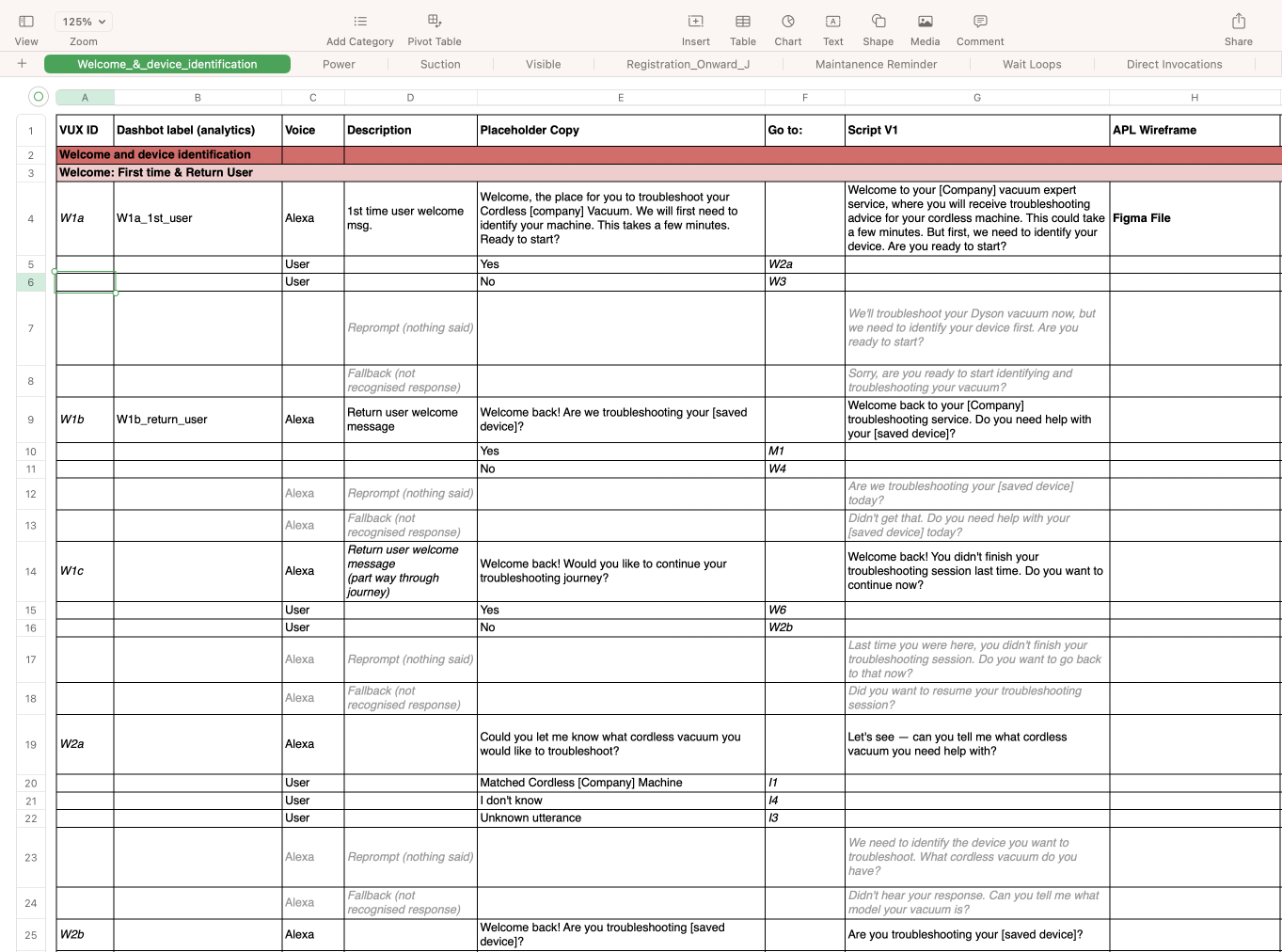
Building user flows and writing the copy for the conversation flow (low fidelity)
I audited and catalogued all the troubleshooting and resolution content, such as videos, articles, and instructions. I organised the information and found the content that needed to fulfil the types of pathways that would be needed.
I tested early flows and conversational pathways within table reads with colleagues not involved in the project. This helped identify areas of friction such as unhelpful technical jargon and create early flows and script.
In store visit - oxford st, london
Understand the mechanics of the vacuums to support the description of tasks and finding nuances with the different machines.
To get a deeper understanding of the various product models, I visited the LVC’s store in London and deconstructed and reconstructed them. This activity not only enabled me to comprehend the processes involved to fix a machine but also the nuances, including the necessary force, the functionality of clasps, and the simplicity of removing parts. Following this, I improved the copy and flow charts ready for usability testing.
usability testing Before handing off to build
Three rounds of usability testing highlighted frictions in areas of the conversational flow and un-friendly user language.
I conducted three rounds of usability testing, with each test comprising five participants. Through these tests, I identified areas of friction within the system and terminology that didn't resonate with users. Based on these insights, I iterated on the system flow to create a more seamless user experience. If budget had allowed, I would have liked to conduct a card sorting activity to further refine the system's information architecture and understand the mental models of users in more depth.
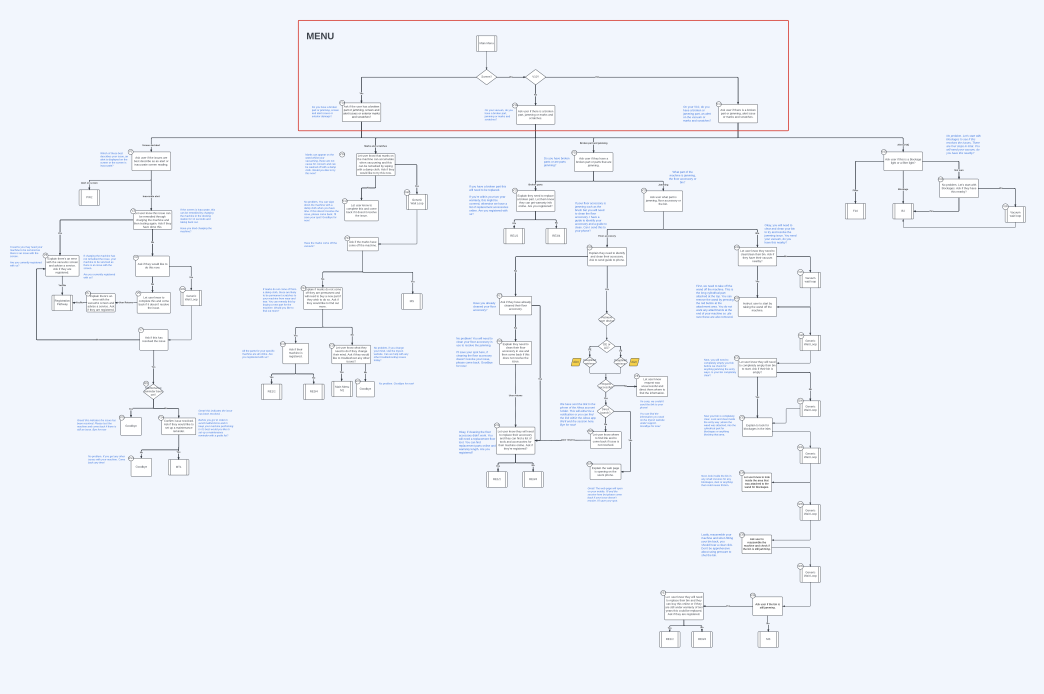
User Flow 1/6
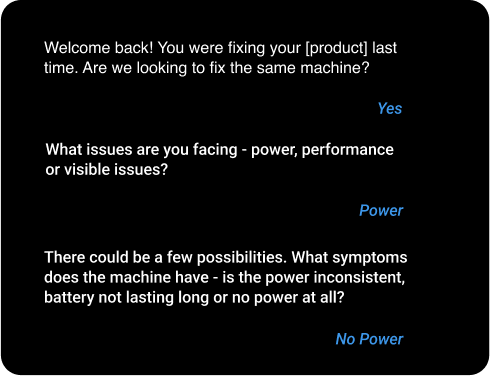
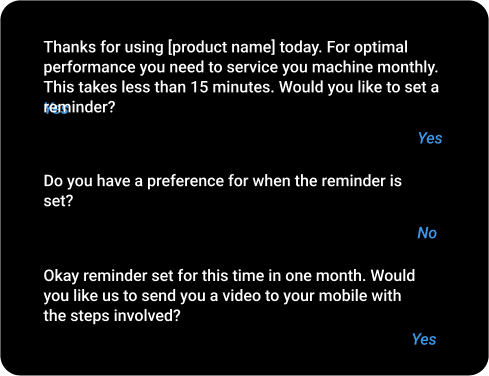
sample script