DYSON
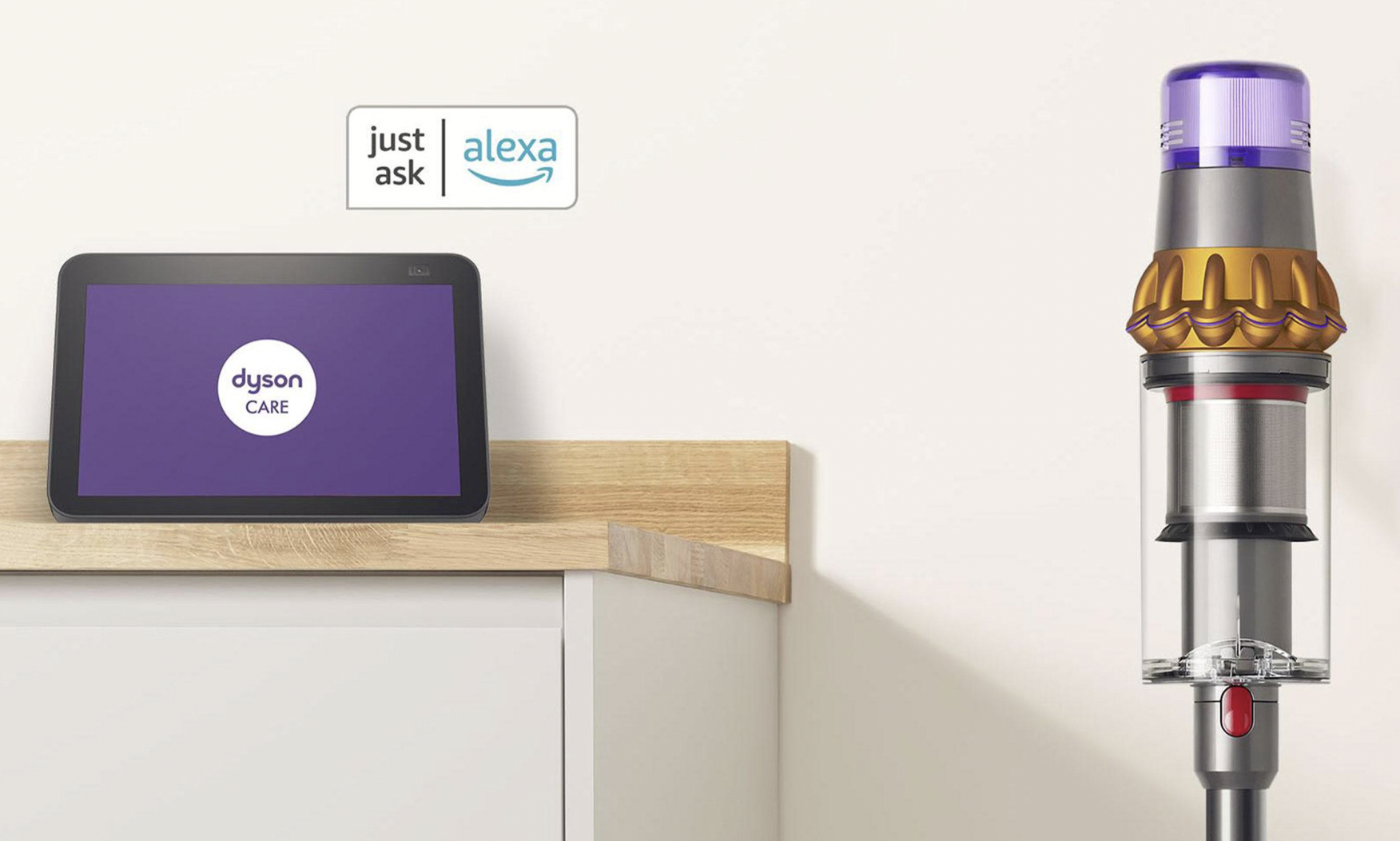
Working at Vixen Labs as lead UX Researcher and Conversation Designer, and alongside a product manager, I led the research and design of Dyson Care — a first of its kind voice skill for the floor care industry, built for Alexa and piloted in the US and Germany. The project won Gold at the Digital Impact Awards 2023 for Best Use of Audio.
Self-Service at Scale for Dyson
Role: Lead UX Researcher & Conversation Designer
Deliverable: Voice AI Skill — Alexa
Impact: Gold, Digital Impact Awards 2023 — Best Use of Audio
Problem: High volumes of customer service calls and emails were unsustainable, with an average handling time of 14 minutes per call. Users couldn't self-serve effectively and machines were breaking due to poor maintenance habits.
Organisational Context: Due to spare parts supply issues, Dyson was replacing entire machines rather than individual components. A hidden cost compounding an already strained customer service operation.
01 — The Problem
A high volume of customer calls and emails were putting significant strain on customer service, with an average handling time of 14 minutes per call.
The website already hosted a self-service resolution pathway, but Dyson's call centre number was prominently signposted across the site — routing customers to the phone before they'd had a real chance to self-serve.
The majority of those calls were for problems that could have been resolved at home with basic maintenance. And for machines that couldn't be fixed remotely, spare parts shortages meant Dyson was replacing whole units rather than individual components. A hidden cost compounding an already stretched operation.
The question wasn't just why people were calling. Interviews with the customer service team revealed that customers genuinely valued being talked through problems, they found it reassuring. The challenge was how to replicate that experience at scale, without a 14 minute phone call, and without compromising the exceptional service Dyson is known for.
02 — Research Questions
Before any primary research began, Dyson provided an exceptionally rich dataset — call centre logs, owner segmentation data, repair and exchange costs, and web analytics. Four days were spent navigating, prioritising, and understanding what it could and couldn't answer. Knowing what to look for in a dataset of that scale was as important as any analysis that followed.
The data shaped the brief. It told us where the business pain was concentrated, which problems were most frequent, and where the biggest opportunities for intervention sat. The research questions were built from that foundation.
Q1 Why are customers calling instead of self-serving?
Q2 Which problems are actually resolvable at home?
Q3 How are they currently planning and solving for changes in legislation?
Q4 Who is making the core decisions around the distribution of finances relating to decarbonisation?
03 — RESEARCH & DISCOVERY
Call Centre Data Analysis
Call logs were categorised across three tiers: problems fully resolvable at home, problems partially resolvable, and problems requiring 1:1 support. Performance and power issues dominated across all channels — pointing clearly to where any intervention could have the most impact.
Call Centre Data Interviews
To understand what was driving those performance and power contacts, I spoke directly with support agents. The pattern was consistent: customers were confused about why their machine had stopped working, often unaware that routine maintenance was required at all. Agents also noted that being talked through a diagnosis was something customers genuinely valued — they found it reassuring rather than frustrating. That quality of guided experience would need to carry into any digital solution.
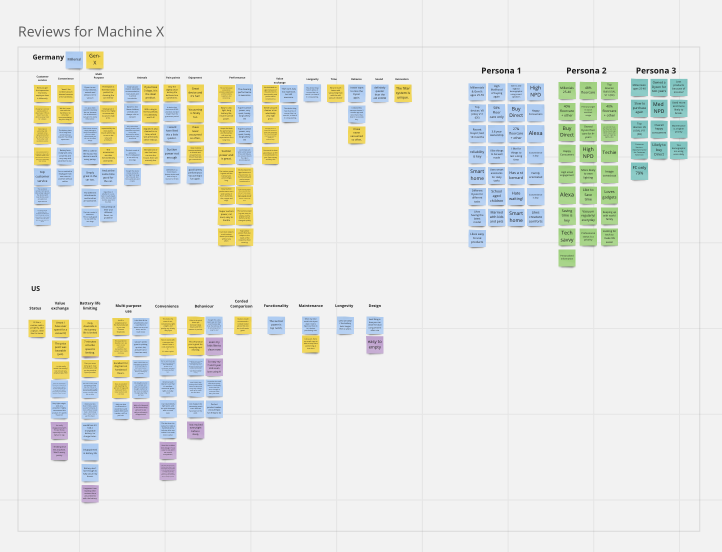
Customer Review Mining
To understand what was driving those performance and power contacts, I spoke directly with support agents. The pattern was consistent: customers were confused about why their machine had stopped working, often unaware that routine maintenance was required at all. Agents also noted that being talked through a diagnosis was something customers genuinely valued — they found it reassuring rather than frustrating. That quality of guided experience would need to carry into any digital solution.
Heuristic Evaluation & Web Analytics
The website already hosted a capable self-service resolution pathway, but a high bounce rate suggested users weren't engaging with it. A heuristic evaluation revealed why — the call centre number was over-prominently signposted, actively routing users to the phone before they'd tried to self-serve. The resolution pathway itself was dense and technical, creating cognitive overload for someone already frustrated with a broken machine.
Journey Mapping
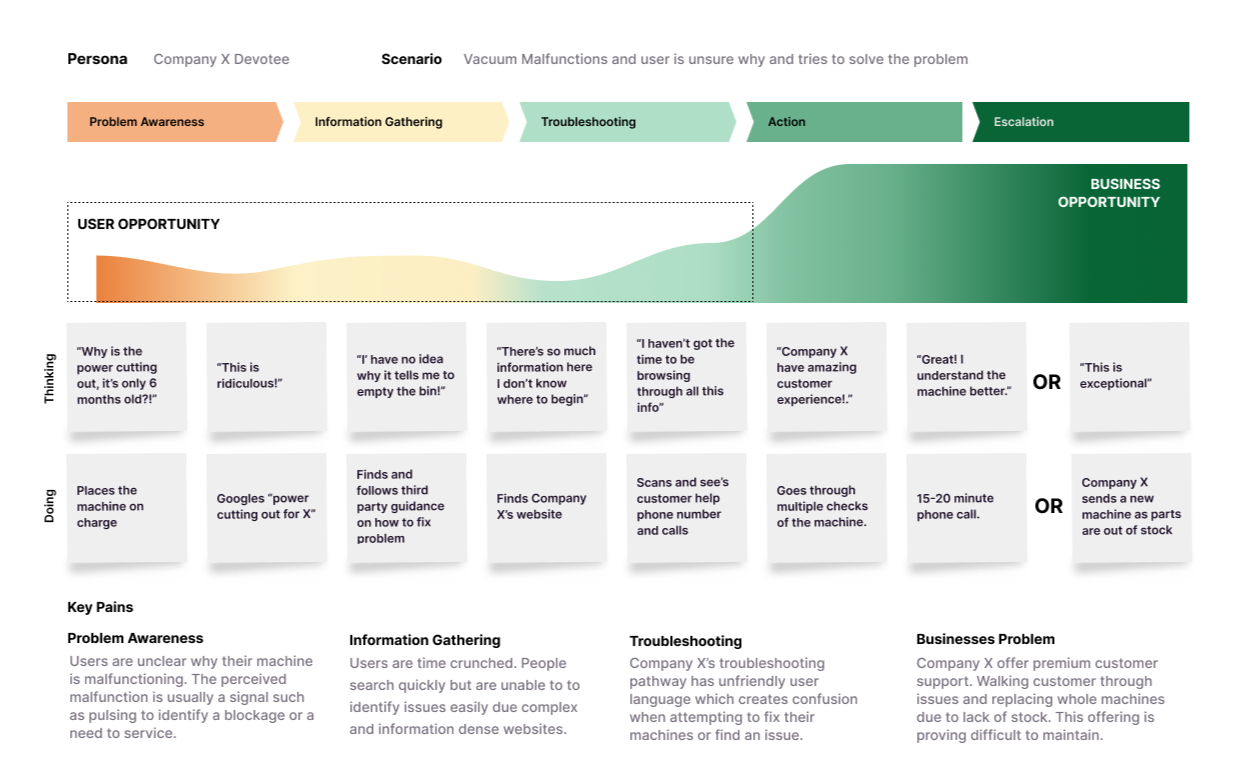
A journey map was built from scratch, drawing on everything the data had revealed. Problems were attached to each stage of the journey — from the moment a machine malfunctioned through to resolution or escalation. This gave a clear visual picture of where users were struggling, where the business was absorbing cost, and where a voice skill could most effectively intervene.
“How Might We?” Workshop
I led a How Might We workshop with the Dyson team, using the journey map as the foundation. Potential solutions were ideated against each problem area — drawing on the research data alongside the team's own domain knowledge. Dot voting surfaced the strongest candidates to take forward.
Story Mapping and T-shirt Sizing
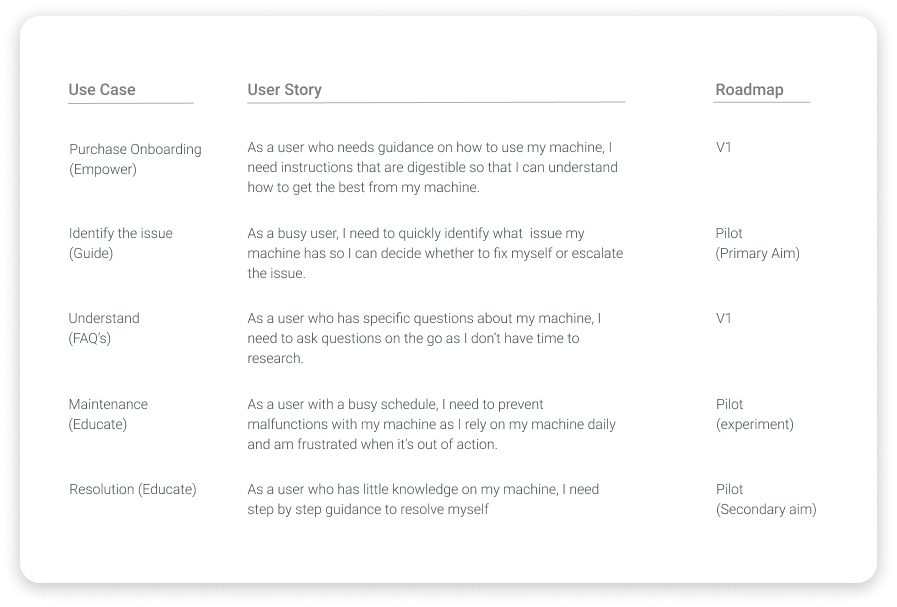
The prioritised solutions were taken into a story mapping exercise, cross-examined against the journey map to assess how well each addressed the identified problems. T-shirt sizing with the development team established what was technically feasible within the MVP. This gave a shared, evidence-based view of what to build first — and a roadmap for what could follow.
04 — FINDINGS
Maintenance unawareness was the primary call driver
Customers were genuinely surprised when told their machine needed regular cleaning. This wasn't a product fault — it was a communications gap that had never been addressed proactively. The website wasn't surfacing maintenance information until after something had gone wrong.
A single thread ran through everything the research revealed: customers didn't know their machines needed maintenance, nothing in Dyson's ecosystem was telling them, and the business was absorbing the cost of that gap at scale.
The website was routing users to the phone
The call centre number was more prominently signposted than the self-service resolution pathway — actively directing customers to the most expensive support channel before they'd had a chance to help themselves.
Usage patterns were accelerating damage
Cordless vacuums were being used far more frequently than previous models. Busy households, often with children and pets, were vacuuming daily — placing sustained strain on machines with no corresponding maintenance habits to match.
Most problems were home-resolvable
Categorising call types across three tiers showed a large proportion of contacts could be fully or partially resolved without agent support — customers just needed the right guidance at the right moment.
The solution was simpler than the problem suggested
Despite the volume and cost of contacts, the underlying issues were remarkably consistent. The same three fixes came up on repeat — cleaning the filter, clearing the head, or replacing the battery. This repeatable pattern meant the problem was well-suited to a guided, self-service solution. Users didn't need an engineer, they needed clear instructions at the right moment.
The cost of doing nothing was growing
Despite the volume and cost of contacts, the underlying issues were remarkably consistent. The same three fixes came up on repeat — cleaning the filter, clearing the head, or replacing the battery. This repeatable pattern meant the problem was well-suited to a guided, self-service solution. Users didn't need an engineer, they needed clear instructions at the right moment.
05 — Design & Build
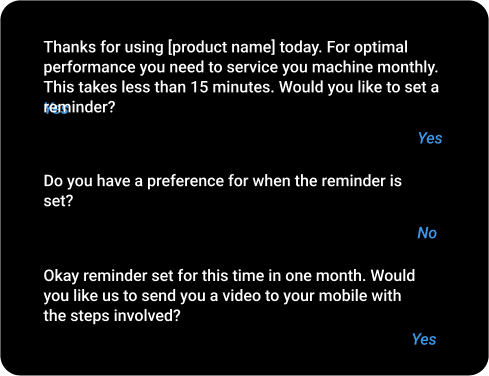
The research pointed to a clear opportunity: a guided, voice-first experience that could walk customers through diagnosis and resolution hands-free — while they worked on the machine. The skill wasn't designed to solve everything. Its primary aim was to intercept the repeatable, home-resolvable issues that were driving the highest volume of contacts, and escalate quickly when human support was genuinely needed. A maintenance reminder was built in as a secondary aim — a monthly prompt to clean and service the machine, addressing the root cause upstream before problems occurred.
Content Audit & Information Architecture
Working with a junior designer, every piece of troubleshooting content on the Dyson website was catalogued — videos, articles, step-by-step guides — into a single spreadsheet. The relevant resolution pathways for cordless vacuums were then identified and mapped. For a voice skill, information architecture decisions carry particular weight — users rely on memory to navigate menus, so categories had to be immediately familiar and limited in number. The audit fed directly into a category structure built around how users actually think about their machine problems: power, performance, and visible issues.
Conversation Design & Scripting
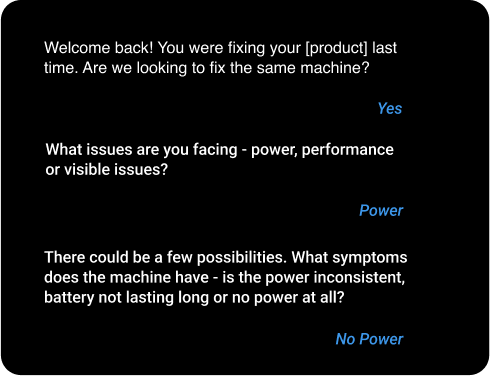
Writing for voice is fundamentally different from writing for screen. Every prompt had to be short enough to hold in working memory, clear enough to act on while holding a vacuum, and warm enough to feel like Dyson. Early conversational flows and resolution pathways were tested in table reads with colleagues to identify friction and unnatural phrasing before anything was built — a quick, low-cost way to sense-check the logic before moving into prototyping.
In-Store Visit — Oxford Street London
Before building in Voiceflow, I visited Dyson's Oxford Street store with a junior designer to deconstruct and reconstruct every cordless vacuum model. Understanding the physical reality of each machine was essential — how much force was needed to open certain areas, how clasps worked, what sounds a user should expect when they'd done something correctly. One consistent call centre issue was customers reporting their vacuum wasn't working when in fact they weren't applying enough force to close the machine properly. Getting this right in the script meant the voice guidance could be genuinely useful rather than generically descriptive.
Voiceflow Prototyping
Conversational flows were built and tested in Voiceflow before any development began — focusing on the most complex pathways and error states. This identified length and complexity issues early and cheaply, and gave a realistic sense of how the skill felt to use before committing to build.
Usability Testing
Two rounds of usability testing were conducted remotely — one at Vixen Labs and one with Dyson customers. Remote testing was a deliberate choice: it replicated the real conditions of using a voice skill, where there's no in-person presence to fill gaps. Some descriptions of machine parts caused confusion and were refined. The core information architecture held up well across both rounds.
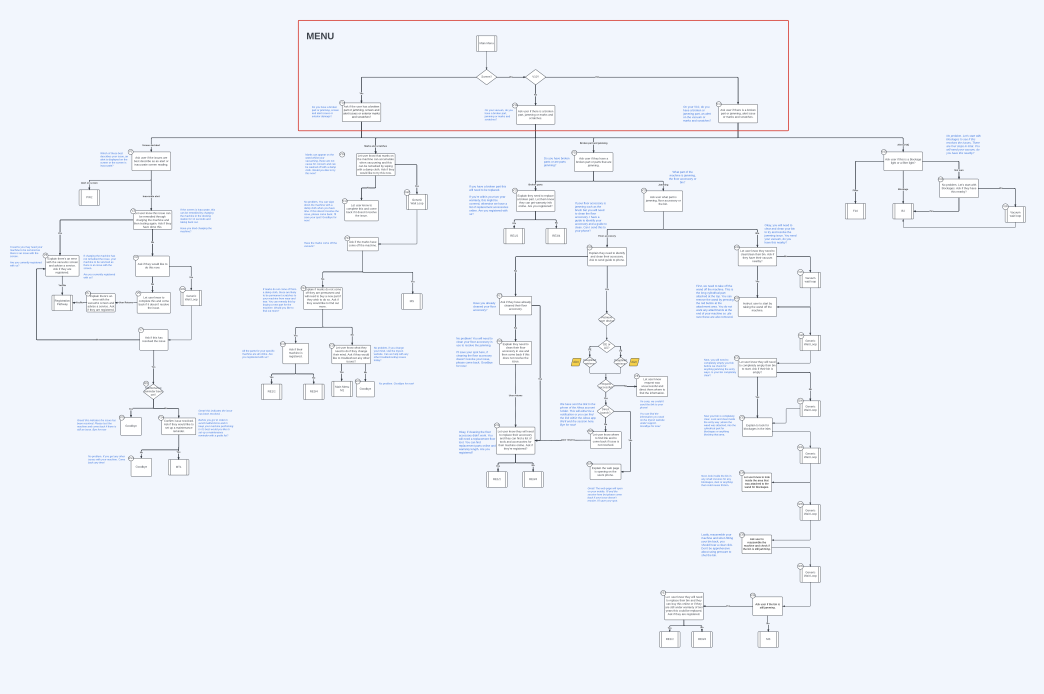
Following testing, a full tree diagram was created mapping every pathway and error state before handoff to development. UX copy was written and passed to the creative team to add any tonal flourishes needed.
Visual Design
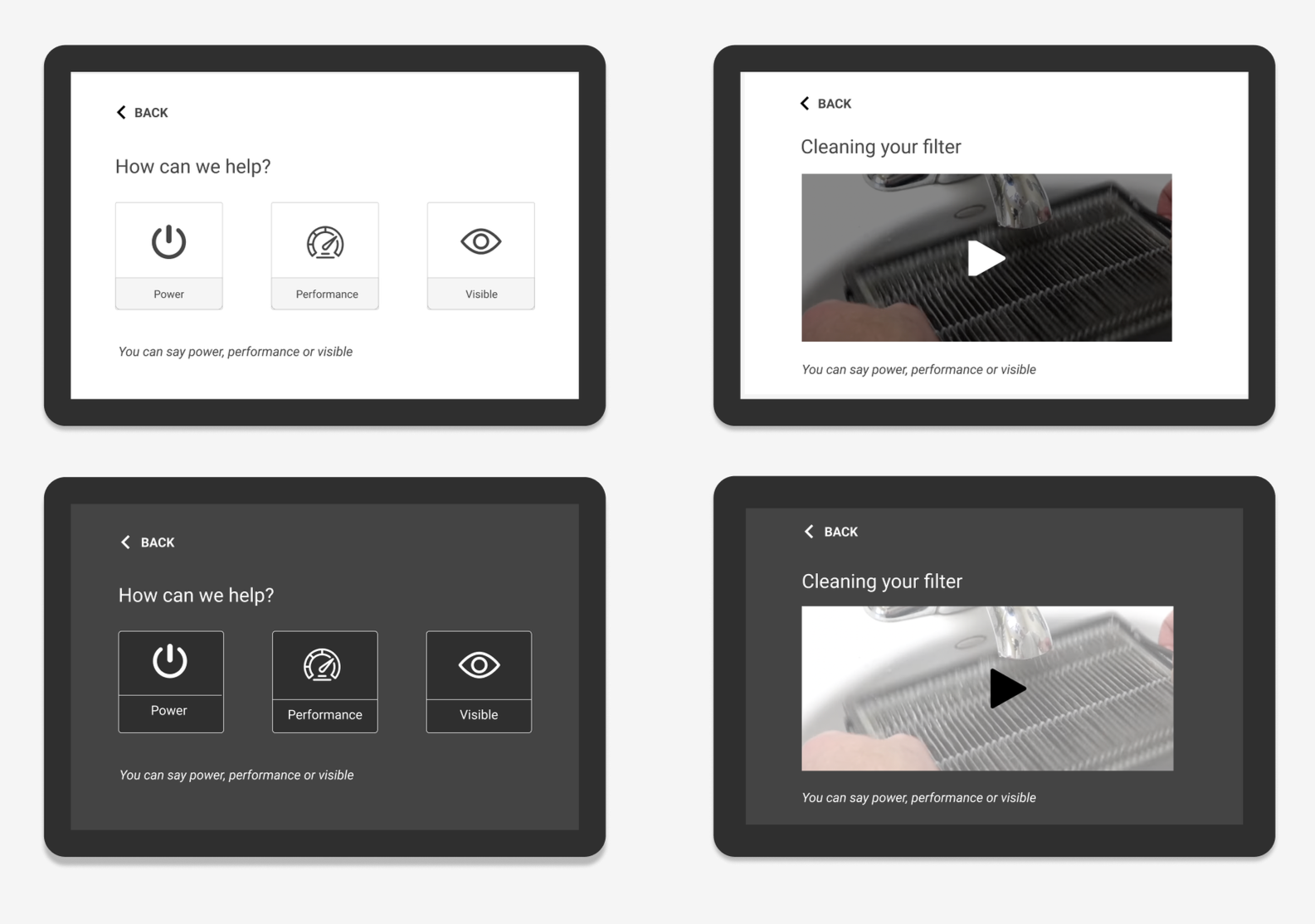
Working within Dyson's brand guidelines, the visual layer of the skill was designed for Alexa devices with screens — supporting the voice experience with clear, simple visuals. Two modes were designed, light and dark, with a minimal interface built around three core categories: Power, Performance, and Visible. Where the resolution required a visual demonstration, instructional video was integrated directly into the screen experience.
06 — outcome
Dyson Care launched in mid-December 2022 as a first-of-its-kind voice skill for Dyson and the floorcare industry, piloted in the US and Germany in English and German. The skill guides users through step-by-step diagnosis and resolution of performance, power, and visible issues — hands-free, while they work on their machine. A built-in maintenance reminder encourages monthly servicing, addressing the root cause identified in research.
In 2023, Dyson Care and Vixen Labs won Gold at the Digital Impact Awards for Best Use of Audio.